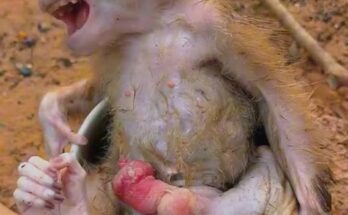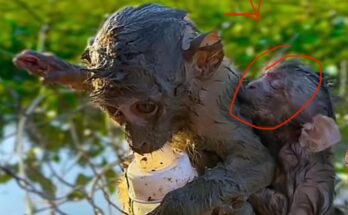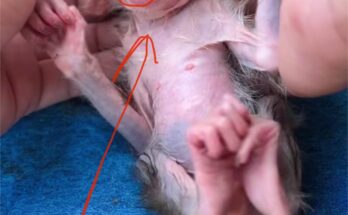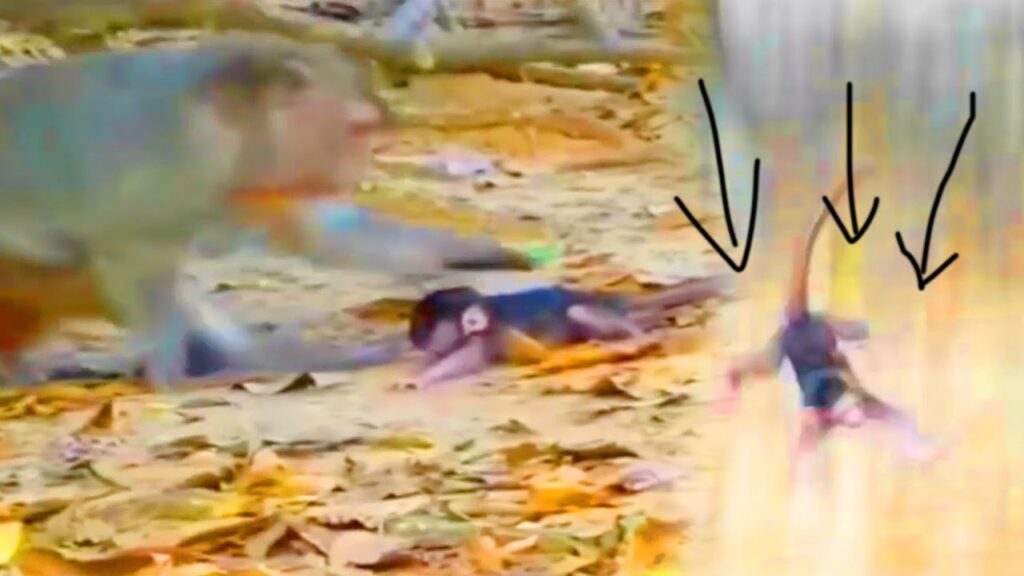
The baby, barely bigger than a hand, clung instinctively to his mother’s fur. His tiny fingers, trembling with the effort of his very first movements, searched desperately for a stable grip. But each time he tried, his fragile body slipped downward. His mother—exhausted, distracted, or simply struggling from the hardships of life in the wild—was not holding him as carefully as newborns typically need.
With every fall, the baby let out soft, confused cries. These faint sounds carried a mix of fear and longing, the natural reaction of a newborn who expected warmth and security but instead found instability. His wobbly attempts to climb back toward his mother’s chest showed both courage and desperation. Still, he continued to slide, his tiny body dropping again and again.
The mother monkey appeared torn between instinct and exhaustion. At moments, she glanced at her baby, lifting a hand as if to steady him. But her reactions were slow and uncertain. Whether she was too tired, inexperienced, or unwell, something kept her from providing the tight, protective hold that newborns rely on for survival. Her posture was loose, her attention unfocused, and her grip far too weak to support her child.
Such scenes are difficult to witness. In the natural world, mothers often face challenges that humans rarely see—lack of food, physical stress, environmental dangers, and the overwhelming strain of giving birth without assistance. These pressures can affect even the most caring animals, leaving their newborns vulnerable in moments that should be tender and safe.
Still, the baby monkey did not give up. Despite tumbling from his mother’s arms again and again, he kept trying to return to her side. His instinct to survive was strong, guiding him back toward the warmth of her body. Every movement he made showed an incredible will to cling to life, even when the comfort he sought seemed unreliable.
For observers, the moment was both heartbreaking and powerful. The contrast between the baby’s helplessness and his determination created a scene that touched anyone who saw it. Even in his struggles, the tiny monkey displayed resilience—an unspoken promise that he would continue fighting to find his place beside his mother.
Though the mother’s hold may have been weak, the bond between them was still present in small ways: a glance, a soft sound, a slight shift of her body toward her child. These subtle gestures showed that, despite her challenges, she had not fully abandoned him. In the wild, such small signs of connection can be the beginning of recovery for both mother and baby.