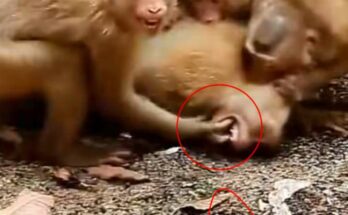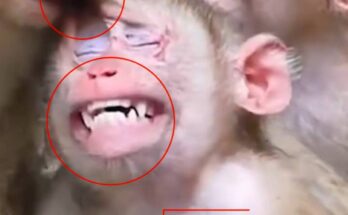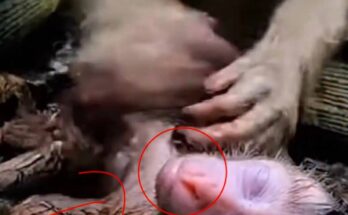
The infant’s fur was still damp, its eyes barely able to open. Its fragile chest rose and fell rapidly with fear. Each cry carried a mixture of confusion, pain, and instinct—a plea for warmth, protection, and the safety only a mother could give.
A few minutes earlier, the mother monkey had been there. She had given birth in a quiet patch of forest, hidden among roots and low branches. But something had gone terribly wrong. She hovered nervously at first, watching the newborn with wide, uncertain eyes. Her body trembled. Perhaps it was fear. Perhaps exhaustion. Or perhaps she sensed something about the infant—weakness, illness, or simply the overwhelming responsibility she wasn’t ready to face.
In a moment of panic or instinct, her fear overtook her instinct to nurture. She backed away. Then, heart pounding, she climbed up the nearest tree, glancing down once more before turning her back completely. The newborn’s small body was left behind on a bed of leaves.
Now, on the ground, the baby monkey continued to cry—loud, raw, and heartbreaking. Its tiny fingers curled and uncurled, searching for something to hold. The world was suddenly too big, too cold, too unfamiliar. Without warmth, newborn monkeys cannot regulate their temperature. Without milk, they weaken quickly. Without a mother, the forest becomes a dangerous place filled with predators, hunger, and fear.
But even in the heart of the wild, abandonment does not always mean the end.
A rustle sounded from a branch above. Another female monkey—older, experienced, and known in her troop for her calm nature—heard the newborn’s cries. She paused, listening carefully. She recognized the distress, the unmistakable sound of a baby left alone. Slowly, she climbed down, inch by inch, her posture gentle and nonthreatening.
She approached the crying infant and sat nearby for a moment, observing. She sniffed the air and tilted her head, assessing the tiny creature. The baby sensed her presence and cried louder, as if begging her to stay.
The female monkey hesitated. Adoption is rare among wild animals, especially among monkeys, who bond strongly with their own offspring and are cautious around others. But the newborn’s trembling body stirred something deep within her. Maybe it was maternal instinct. Maybe compassion. Or maybe the simple fact that life in the forest is harsh, and every small chance to protect a vulnerable life matters.
Slowly, gently, she reached out and touched the newborn’s back. The infant quieted slightly at the sensation—warmth, finally warmth. After another moment of hesitation, the female gathered the tiny monkey into her arms. She held it close to her chest to warm it, her fur enveloping the weak body like a soft blanket.
The newborn stopped crying. For the first time since its birth, it felt the comfort of another heartbeat.
High above, hidden in the foliage, the biological mother watched from a distance. Her eyes reflected conflict—fear mixed with something deeper, maybe regret, maybe confusion. But she didn’t move closer. The responsibility had passed. And the forest had chosen another path for the infant.
As the troop moved on later that day, the adoptive female carried the newborn with careful tenderness. She groomed its tiny head, offered the safety of her arms, and remained alert to every sound around them. The cries of the abandoned baby had transformed into soft, sleepy murmurs—a fragile life beginning again with a second chance.
In the vast, unpredictable world of the wild, survival often depends on instinct, luck, and timing. But sometimes, as in the case of this newborn monkey, it is saved by something even more powerful: unexpected compassion.
Though the mother had abandoned her newborn on the cold ground, the forest found a different guardian for the tiny life. And as the troop disappeared into the trees, the baby monkey’s future—once so uncertain—now carried a spark of hope.