But the one who could give him all of that was only a few steps away…and she was not responding.
The mother monkey sat on a thick branch, her body angled deliberately away from the little one lying beneath her. She glanced down occasionally, but each time, her gaze seemed unsure, hesitant, and distant. She was young herself—barely old enough to understand motherhood. Her instincts fought with her uncertainty, and the uncertainty kept winning.
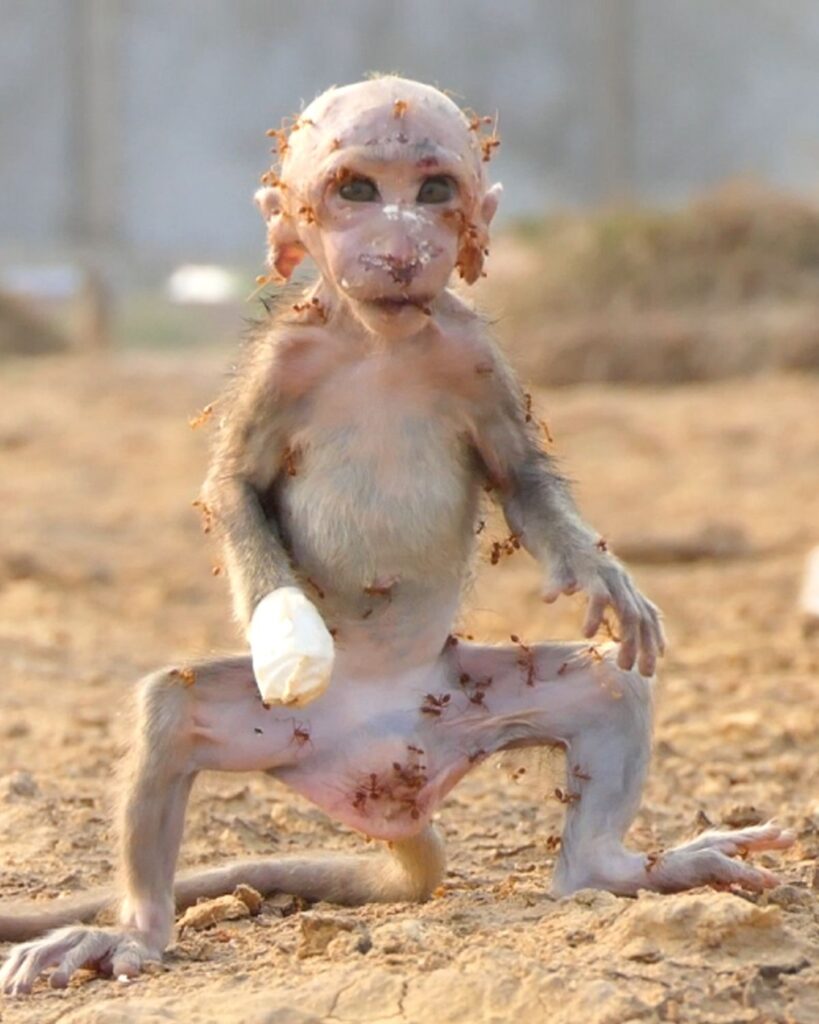
Below her, the tiny baby squirmed, emitting soft squeaks that cut through the morning stillness. His world was confusion and coldness. He didn’t understand why the comforting source of warmth, the heartbeat he knew all his life, was suddenly gone.
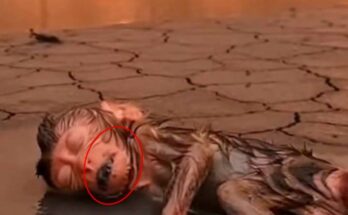
He pushed himself forward with his weak limbs, dragging his small body across the dirt. His movements were clumsy but filled with determination. He didn’t know how to survive on his own—he only knew that he needed her.
The mother shifted uncomfortably on the branch. She heard him. She felt the tug in her instinct. But something held her back. Perhaps fear of her new role. Perhaps stress from her surroundings. Perhaps she simply did not yet recognize him as her own. In the animal world, these moments—though heartbreaking—are real.
The baby let out another cry, louder this time. His hunger was deepening. His tiny belly felt hollow, and every breath came with more effort. Milk was not just food—it was warmth, protection, and life itself. Without it, he grew weaker by the minute.
He collapsed briefly, exhausted from the effort of crawling. His body shivered uncontrollably. The cold pressed against him relentlessly. His eyes, barely open, blinked slowly as he tried once again to call for his mother.
Up above, the mother monkey finally climbed down. For a moment, hope flickered in the newborn’s movements. His tiny arms stretched toward her, trembling with urgency. He recognized her scent, the familiar presence he clung to even before birth.
But instead of picking him up, the mother simply circled around him, sniffing, hesitating. She looked nervous, unsure. She nudged him slightly with her foot—not with aggression, but with confusion, as if trying to decide if he truly belonged to her.
The baby made another desperate sound. This time, his voice cracked. His body sagged with exhaustion. He needed to be held. He needed her warmth pressed against him. He needed milk to give his tiny heart strength to keep beating.
Yet the mother stepped back.
She climbed onto a nearby rock, glancing down at him with conflicted eyes. Her instincts were fighting each other. Her youth and inexperience pulled her away, while a faint maternal urge tried to push her toward him. The struggle inside her left her motionless.
Minutes passed—long, painful minutes in the life of a newborn. The baby monkey lay there, breathing unevenly. Each breath was weaker than the one before. His body curled into itself, trying to conserve what little warmth remained.
But even in his exhaustion, he reached outward again—tiny fingers stretching toward a mother who wasn’t responding.
The forest seemed to watch in silence.
A breeze moved through the trees. Leaves rustled softly. But nothing changed. The mother remained distant, perched where she felt safe, still unsure of the tiny life calling out for her.
The baby whimpered one last time—a soft sound, barely above a whisper. A plea. A question. A hope.
He only wanted milk.
He only wanted comfort.
He only wanted his mother.
Whether the mother would eventually accept him or continue to keep her distance was a story the forest would witness in the hours to come. But in that moment, one truth stood painfully clear:
Even the smallest creatures know what love feels like—
even if they have never received it.