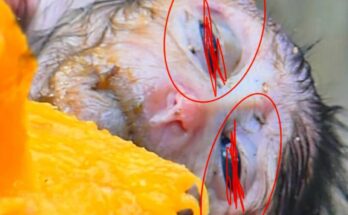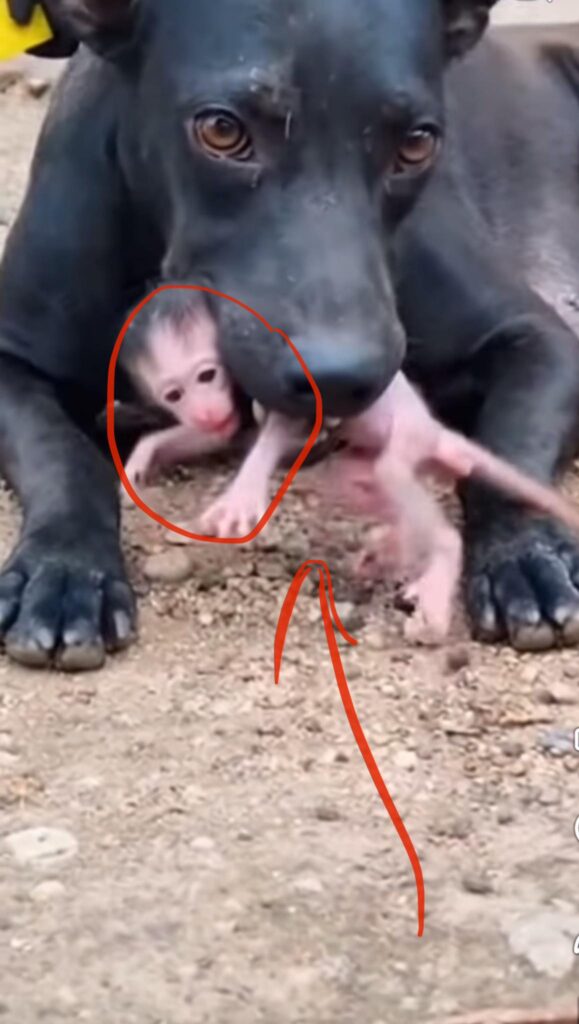
The morning was quiet in the forest, the kind of stillness that makes every leaf seem important. Sunlight filtered through the trees, touching the ground in scattered patches of gold. High on a branch, a mother monkey cradled her newborn, a life only moments old, still unfamiliar with the world it had just entered. The infant clung instinctively, unaware of danger, hunger, or fear—knowing only warmth and the steady rhythm of its mother’s breath.
At the forest’s edge, however, something was wrong.
A rabid dog, driven by illness and confusion, wandered without direction. Rabies strips animals of their natural balance, replacing instinct with aggression and fear. The dog no longer recognized the boundaries between the village and the wild, between prey and peace. Its movements were erratic, its eyes unfocused, its body acting on impulses it could not control.
The encounter happened in seconds.
A sudden noise startled the mother monkey, forcing her to leap lower in the trees. Before she could escape, the dog lunged. The newborn, helpless and fragile, became the unintended victim of a disease that does not choose with cruelty, but with indifference. The bite was fatal, and the infant’s life ended before it had truly begun.
The forest fell silent again, but it was no longer the same silence.
This tragedy was not just the story of a single loss. It was a reflection of a larger, unsettling truth about the fragile balance between humans, animals, and nature. Rabies is a preventable disease, yet it continues to claim lives—human and animal alike—because of neglect, lack of awareness, and poor management of stray animal populations. The dog was not born dangerous; it became so through abandonment and illness left untreated.
For the mother monkey, the loss was immediate and devastating. Animals grieve in ways humans often fail to acknowledge. She remained near the spot, calling softly, holding the lifeless body as if waiting for movement that would never come. In that moment, the line between human sorrow and animal sorrow disappeared. Grief, after all, is universal.
The newborn monkey represented innocence in its purest form. It had no role in the chain of events that led to its death. Yet nature is often unforgiving, especially when human actions disrupt its balance. Expanding cities, unmanaged waste, and unvaccinated stray animals create intersections where tragedy becomes inevitable. What happened was not simply an accident—it was a consequence.
This incident serves as a quiet warning. Protecting wildlife does not only mean saving forests or banning hunting; it also means addressing the diseases and conditions that spill over from human environments into the natural world. Vaccinating stray dogs, supporting animal welfare programs, and respecting wildlife habitats are not acts of charity—they are responsibilities.
The death of the newborn monkey may go unnoticed by the wider world, but it carries meaning. It reminds us how vulnerable life is, and how quickly it can be lost when care is absent. One small life ended, but the lesson it leaves behind is large: coexistence requires compassion, foresight, and action.
In the end, the forest continued to breathe, trees swayed, and the sun rose the next day. But somewhere among the branches, a mother’s arms were empty—a silent testament to a world where preventable suffering still finds its way into the wild.