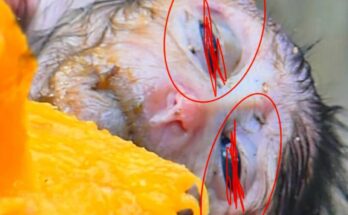
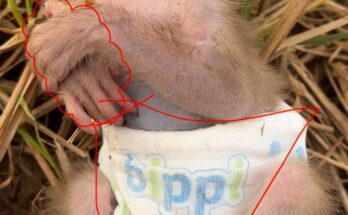
Life in the wild is governed by unforgiving rules, and among primates, survival often comes at a devastating cost. The killing of a baby monkey by an adult—an act that appears senselessly cruel to human observers—is in fact a grim reflection of evolutionary pressures that shape primate societies. This harsh reality reveals how survival, dominance, and reproduction can outweigh compassion in the natural world.
In many primate species, infanticide occurs when a new or dominant male takes control of a group. By killing infants that are not his own, the male accelerates the reproductive cycle of the females, increasing his chances of passing on his genes. While shocking, this behavior is not driven by malice but by instinct, reinforced over generations through natural selection. In environments where resources are limited and competition is fierce, such actions can determine which genes endure.
For the mother and the group, the loss of an infant is traumatic. Mothers may mourn, protect the body, or withdraw socially, demonstrating that primates possess deep emotional bonds and awareness. Other members of the troop may respond with stress or aggression, underscoring how a single act of violence can disrupt the delicate balance of social life.
Yet these same primate societies also show cooperation, caregiving, and complex relationships. Grooming, shared defense, and communal child-rearing coexist alongside violence, illustrating the dual nature of survival. Primate life is not defined solely by brutality, but by a constant tension between empathy and instinct.
The death of a baby monkey serves as a stark reminder that nature is neither kind nor cruel—it is indifferent. In this world, survival of the fittest is not a slogan, but a lived reality, where life continues forward, even in the shadow of loss.