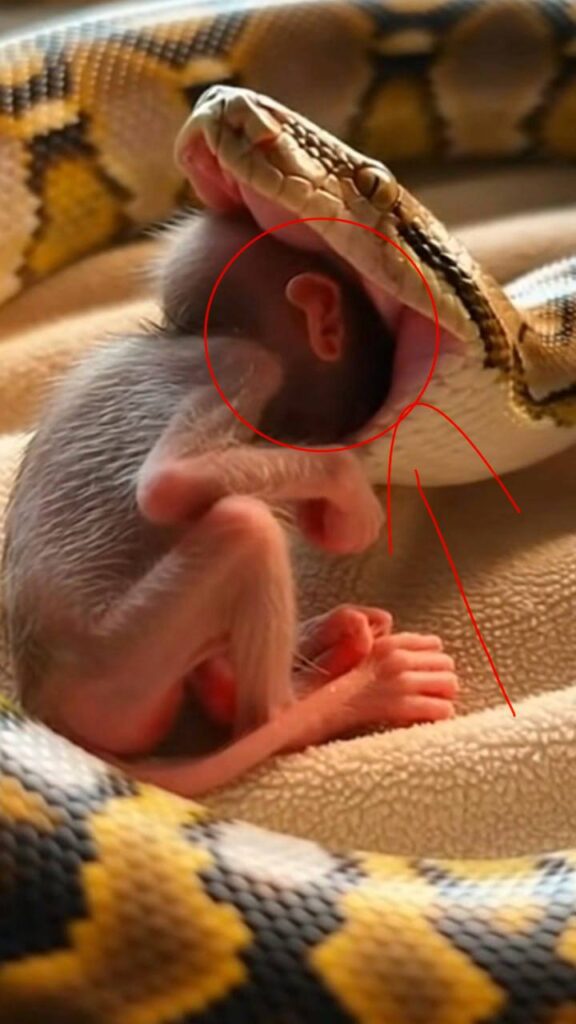
In the natural world, survival often unfolds in ways that are difficult for humans to witness or understand. One such moment occurred deep within a tropical forest, where a giant python and a newborn monkey crossed paths—an encounter that reminds us of both the beauty and brutality of nature.
Pythons are among the most powerful predators in their ecosystems. Silent, patient, and highly adapted, these large snakes rely on camouflage and stealth rather than speed. Unlike animals that hunt in packs, a python survives alone, depending entirely on instinct and opportunity. Every successful hunt may determine whether it eats or starves for weeks.
Monkeys, on the other hand, are social animals. They thrive in groups, relying on community, communication, and constant movement for safety. Newborn monkeys are especially vulnerable during their earliest days of life. They depend completely on their mothers and the protection of the troop to survive in a forest filled with predators.
On this particular day, the forest canopy was alive with sound—birds calling, insects buzzing, and monkeys moving through the trees. Hidden among the foliage, a massive python lay still, nearly invisible against the forest floor. Such predators can wait for hours, sometimes days, without moving, conserving energy until the right moment arrives.
When wildlife encounters like this happen, they are not driven by cruelty or malice. Animals do not act with moral intent. A python does not understand age, innocence, or emotional bonds. It follows instinct—the same instinct that keeps the balance of nature intact. Predators help regulate animal populations, preventing overgrowth that could damage the ecosystem as a whole.
For humans observing or learning about such events, the emotional response is often strong. Seeing a baby animal involved can be heartbreaking, especially for species like monkeys that display behaviors similar to our own—clinging to parents, expressing fear, and forming close family bonds. These reactions are natural and rooted in empathy.
However, wildlife experts emphasize the importance of understanding nature without projecting human values onto it. Intervening in natural predator-prey relationships can sometimes cause more harm than good. Ecosystems have evolved over millions of years, and each species—predator and prey alike—plays a vital role.
Moments like these also highlight why habitat protection matters. As forests shrink due to deforestation and human expansion, encounters between predators and vulnerable animals become more frequent. Limited space increases competition and reduces the natural safeguards that once protected young animals.
By preserving natural habitats, supporting conservation efforts, and educating ourselves about wildlife behavior, we help reduce unnecessary suffering caused by human interference. Nature is not gentle, but it is balanced—when left undisturbed.
This story, while difficult, serves as a reminder of the raw reality of the wild. Life continues through cycles of birth, struggle, and survival. Understanding these moments with respect and awareness allows us to appreciate the natural world not just for its beauty, but for its truth.