High in the canopy, a mother capuchin monkey scanned the forest floor. Clutched to her chest was her infant, tiny fingers tangled in her fur. Food had been scarce for days. The dry season had thinned the fruiting trees, and competition among the troop was fierce. Hunger sharpened her instincts, pushing her to take risks she would normally avoid.
Her sharp eyes caught movement below—a small frog hopping across a damp patch of leaves. Its colors were unmistakable: bright, defiant, and dangerous. Most predators would steer clear. But capuchins are clever. They have learned that even the deadliest creatures can be handled—if approached with care.
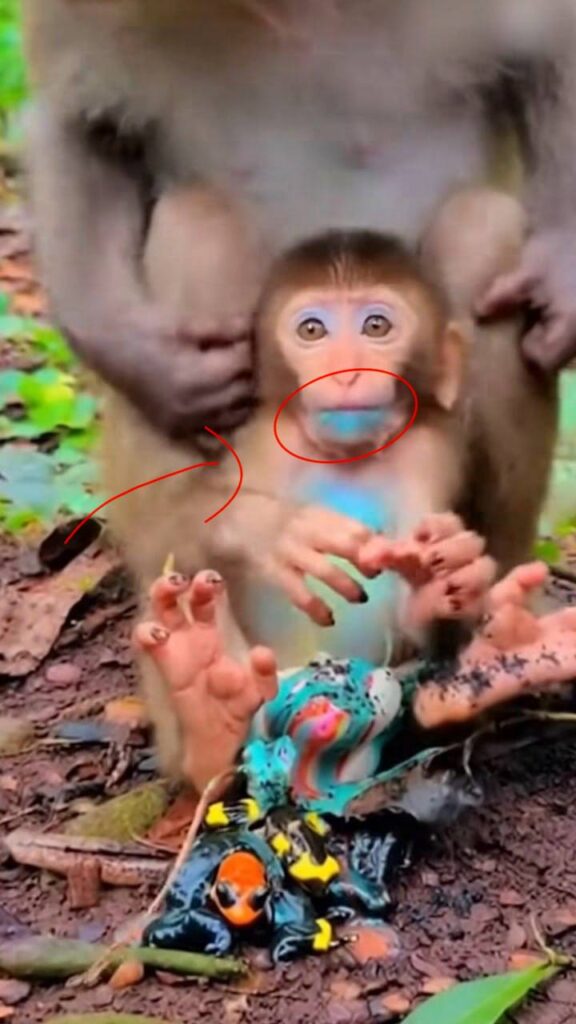
Descending cautiously, the mother positioned her baby securely on her back. The infant chirped softly, unaware of the peril beneath them. With deliberate precision, she pinned the frog using a stick she had stripped from a nearby branch. She never touched it directly. Experience—or perhaps instinct passed through generations—guided her actions.
Poison dart frogs secrete alkaloid toxins through their skin, potent enough to paralyze or kill small animals. Indigenous tribes have long used these toxins to tip hunting darts. For a monkey, a careless bite could mean convulsions, paralysis, and death. But the mother was not hunting for food in the usual sense.
Instead, she began a strange ritual.
Carefully pressing the frog against a branch, she agitated it until the creature excreted more of its toxic secretion. Then, with astonishing boldness, she rubbed the frog’s skin lightly against her own fur—avoiding her mouth and eyes. She repeated the action, coating patches of her body with the toxin before releasing the dazed amphibian back into the undergrowth.
This was not cruelty for sport. It was survival.
Scientists have observed similar behavior in some primates: self-anointing with toxic insects, millipedes, and even frogs. The toxins serve as a natural insect repellent, deterring mosquitoes, ticks, and parasites that spread disease. In the suffocating humidity of the rainforest, where infection can mean death, such protection can be invaluable.
But the act is risky.
Too much toxin absorbed through the skin could sicken her. A misjudged movement could expose her infant. As she groomed herself afterward, she avoided licking the treated fur. Her baby reached curiously toward her shoulder, and she gently nudged its hand away.
Above them, the forest pulsed with life—birds calling, insects buzzing, leaves whispering secrets. The mother climbed back into the canopy, her fur faintly glistening where the toxin had been applied. The frog, spared but shaken, vanished into the foliage.
In the wild, survival is rarely gentle. It is a balance of danger and ingenuity, of risk weighed against reward. The mother’s actions may seem brutal, but they are born of fierce devotion. Every choice she makes—every calculated gamble—is for the small heartbeat clinging to her back.
In a world painted with warning colors and hidden threats, even poison can become protection.