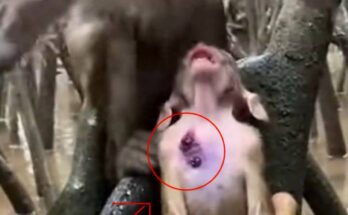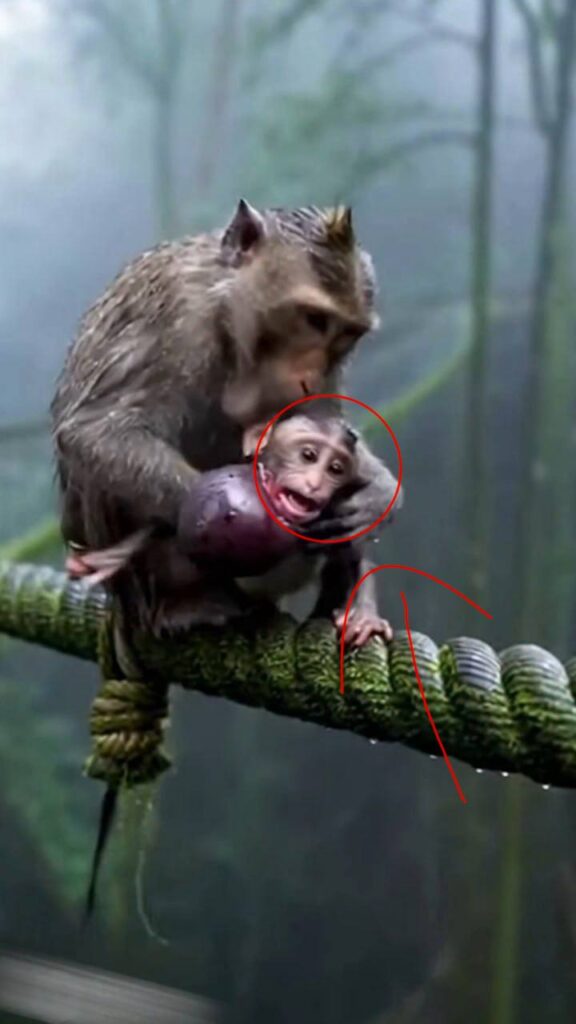
The jungle canopy shimmered in the late afternoon light, a cathedral of green and gold swaying high above the forest floor. In the upper branches of an ancient kapok tree, a mother monkey clutched her infant close to her chest. The world below hummed with life—chirping insects, distant bird calls, and the rustle of leaves stirred by a restless wind. But in her dark, searching eyes, there was no peace. There was only fear.
She was a member of a troop of capuchins, small yet fiercely intelligent primates who had survived generations in this sprawling rainforest. Their lives were ruled by strict hierarchies and unspoken laws. At the top of their social order stood the dominant male—powerful, unpredictable, and intolerant of weakness. When leadership shifted, chaos followed. And chaos, in the wild, often meant death.
The mother had sensed the tension days ago. The old alpha had vanished after a violent clash, and a new male had taken his place. He moved with cold authority, asserting dominance over every branch and body in his reach. She had watched him closely, her instincts prickling with dread. For she knew what sometimes followed such changes: the unthinkable.
In the animal kingdom, survival can demand brutal strategies. A new alpha may eliminate infants sired by his predecessor, ensuring that only his lineage continues. It is a harsh calculus of nature—one that prioritizes propagation over compassion. And so, when the new leader’s gaze fixed on her tiny infant, she felt the world tilt beneath her.
The troop scattered as he approached, but she could not run fast enough. Her baby clung to her, unaware of the danger. The mother’s heart pounded like a drumbeat in the silence of her terror. She leaped from branch to branch, the canopy swaying wildly as if echoing her desperation. Yet she knew the forest was not vast enough to hide forever.
In that moment, suspended between sky and earth, she faced a decision no creature should have to make. To fight would mean certain death—for her and likely for her child. To flee alone would mean abandoning the fragile life she had nurtured. And to stay might mean watching the inevitable unfold beneath the merciless laws of instinct.
She tightened her hold, pressing her infant close as though her embrace could shield it from fate itself. Around her, the jungle’s beauty seemed almost cruel—sunlight filtering through leaves like shattered glass, vibrant orchids blooming in silent indifference. Nature did not pause for grief. It did not judge or console.
When the dominant male drew nearer, she did something astonishing. Instead of resisting, she lowered herself to a branch below, shielding her infant with her body. She presented no challenge, no threat. It was a gesture of submission—a plea written not in words, but in posture. She offered her vulnerability in the faint hope that mercy might bloom where instinct usually ruled.
For a long moment, the jungle held its breath. The male studied her, his expression unreadable. Then, with a grunt of indifference, he turned away, swinging into the higher branches to assert his reign elsewhere.
The mother trembled long after he disappeared. She had gambled everything on a fragile hope. Beneath the endless canopy, she learned that survival is not only about strength—it is also about courage, sacrifice, and the quiet defiance of a mother’s love in a world that rarely shows mercy. 🌳💔🐒